The Snworb
The first thing Maker Bayfield thought after the touchdown was that his hands were no longer hands.
They were old wooden paddles. They were two frozen walleye wearing gloves. They were rumors at the ends of his arms.
He lay on his back in the end zone, looking up into a sky that had become a white wall. Down here, on the lake, in December, in Cleveland, there was only breath.
Breath from eighty thousand people. Breath from Maker himself, ragged and white, as he looked from the brown churn of trampled mud beneath him up to the orange goalpost above.
The ball was still tucked under his right arm.
He had forgotten to let go.
This was understandable. Over the last two minutes and twelve seconds, the ball had become less an object than a legal dependent.
He had taken the snap. He had seen nothing. Then he had seen everything: a brown jersey, an orange sleeve, a linebacker lunging from a place linebackers were not supposed to exist, and a lane opening for half a heartbeat.
Maker ran.
Sometimes the correct read was not in the playbook, not in Dope DePaulsta’s forbidden Moneyball projections, and not in Dr. Selene Hartwell’s astronomical cautions.
Sometimes the correct read was: I sprint now.
He crossed the goal line under three bodies and a meteorological event.
For one second there was silence, the tiny startled silence that comes when a crowd has already spent its entire soul and must borrow against future yelling.
Then Snworb Stadium detonated.
Someone pulled at his shoulder pads.
“Maker! You alive?”
Treselym Trag’s face hovered above him, eyebrows crusted with snow.
“No,” Maker said.
“Great.”
“I have died.”
“Love that.”
“And gone to Cleveland.”
Treselym nodded. “Tracks.”
Maker sat up.
The lake beyond the open end was gone, erased by snow, but he could feel it there, huge and dark and pleased with its effect. The wind came off it sideways, hard enough to make the uprights tremble.
Fans pounded the seats in ponchos, parkas, ski masks, homemade capes, and one full-body reindeer costume whose antlers had iced over.
In the stands just beyond the endzone, three signs rose through the snow:
DOME TEAMS HATE THIS ONE WEIRD LAKE
FROSTBITE BUILDS CHARACTER
SEND THAT FAN SOME SNOW PANTS
Maker laughed, and the laugh hurt his ribs, which made it better.
This, he thought.
This exact ridiculous misery.
This was Cleveland football: the lake breathing murder, the crowd answering with joy, a forlorn opposing offense huddling over heatlamps watching the clock.
Who would want anything else?
The scoreboard glowed through the storm.
SNWORB 24
SUPERCHARGERS 23
The numbers looked less displayed than excavated.
Maker began walking toward the sideline, and that was when Mijah Slammy came into his mind.
Not the man himself. Maker had no desire to picture Mijah Slammy during a sacred moment. It would have been like thinking of a parking invoice during a wedding kiss.
No, what came to him was the letter.
The open letter.
The one Mijah had released three weeks earlier, addressed to Cleveland, its partners, and Future Generations of Subsurface Sports Enthusiasts.
Mijah Slammy, billionaire, menace, and owner of several smiles not found in nature, had proposed that the Snworb leave the lakefront and play underground in a salt mine.
Not metaphorically. Not as protest art.
Mijah meant it. He meant it with renderings. He meant it with a phrase Maker had not been able to forget:
a bold descent into the bedrock of tomorrow.
Maker reached the sideline and looked back at the stands.
The fans were not comfortable. Not one of them. A comfortable person did not have icicles forming in their nostrils nor pay money to stand beside a frozen lake in December and scream until language became vapor.
They were joyous, not comfortable.
Mijah would never understand the distinction.
Maker could hear the letter now, in that smooth dead voice all documents used when they wanted to rob you politely.
The proposed Subterranean Snworb Performance District will provide a weather-neutral environment while preserving Cleveland’s authentic geological identity.
The wind stirred, and snow hammered Maker’s face.
Authentic geological identity.
Above him, the sky was committing assault. That was geological identity.
By relocating beneath the city’s historic salt formations, we honor the region’s industrial heritage while unlocking year-round revenue pathways previously inhibited by legacy exposure models.
Legacy exposure models.
Maker took off his helmet.
The cold hit his sweat-soaked hair and turned every nerve awake. An old man gripped the rail with tears on his cheeks, though perhaps that was snowmelt. He raised one fist. Maker raised the ball. The stadium found another gear.
A gust dumped snow onto the visiting bench. An assistant coach lost a clipboard. It skittered toward the numbers, flipped twice, and died heroically near the twenty-seven-yard line.
Disruptive atmospheric variables one only sees within legacy exposure models, Maker thought.
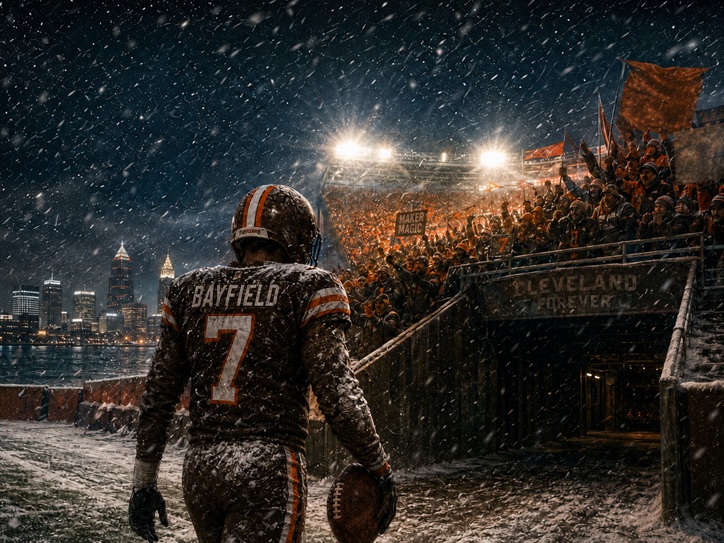
Football in a salt mine? What did that say? Not tradition, not honor, not pride.
It said: we must blame the heavens and surrender.
It said: let us preserve branding while removing place.
It said: we shall bury the people for the futher comfort of the already-too-comfortable.
It did not say Cleveland, and it did not say Snworb.
Treselym shoved Maker lightly.
“You good?”
“I’m thinking about salt.”
“Please don't.”
“Did you read Mijah’s letter?”
“Unfortunately.”
“He really believes it.”
“Maker, Mijah believes luxury boxes should be granted constitutional rights.”
For a moment they stood without joking.
The crowd had begun chanting now.
SNWORB.
SNWORB.
SNWORB.
The word rolled around the stadium, hit the open end, met the lake wind, and came back larger.
Noise did not behave here. Weather did not behave. Football did not behave. Every sensible plan entered Snworb Stadium and left with a bloody lip and a great story to tell.
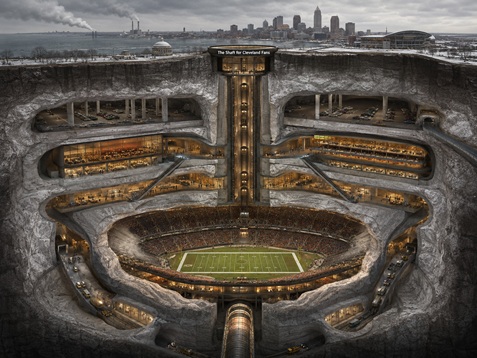
Maker imagined Mijah’s mine: chants dulled by gray walls, suites cut like tasteful bunkers, sponsored pickaxes, digital snow as a visual effect in premium seats, optional, isolated, virtual-reality wind experiences available for twenty-dollars.
He recalled the proposed entry to the salt mine stadium: The Shaft for Cleveland Fans.
What question was football meant to answer?
Mijah’s question was: What can be sold next?
The lake’s question was: How much can you endure?
Above the tunnel, a banner snapped in the wind:
THE JOY FOUNDRY
Through wind and the snow, Maker read:
JOY FOUND
That seemed better.
Then Maker saw a boy pressed against the railing near the tunnel. Maybe eight years old, wrapped in so many layers he was less a child than a load-and-a-half of near-future laundry.
With wide-eyed hope, the boy pushed an orange football and brown pen out toward Maker.
Maker signed. His fingers barely worked. The signature came out jagged and strange, like it had been written during an earthquake or by a quarterback whose hands had briefly become fish.
The boy stared at it with the stunned concentration of someone whose life had just acquired a Before and an After.
Then he shouted, “Don’t let Mijah put us underground!”
The people around him laughed, but not because it was funny.
Maker wanted to say something heroic, something worthy of documentaries and murals. But he was cold, and tired, and happy, and not a speechwriter.
So he leaned close and said, “I like the sky where it is.”
The boy nodded.
Maker turned back toward the field. His teammates were heading for the tunnel now, stomping through snow, laughing, limping, alive. The stadium kept chanting. The lake kept throwing itself invisibly at the shore.
Maker took one last look at the open bowl, at the snow storm, at the place where football did not run from Cleveland but submitted to it, and in submitting became something larger than comfort, larger than revenue, larger than every polished letter ever written by a man who confused possession with love.
Maker Bayfield, dusted in white, walked to the tunnel with winter and the crowd's roar at his back and no roof above him.
Advance Regress